Closed-Loop Marketing: What It Is (and Why Most “AI Marketing” Isn’t)
Right now, the business world is drowning in fake automation.
Every SaaS platform on the market has slapped an “AI powered” label on its dashboard. But if you look under the hood of what most companies call "AI Marketing," you won't find intelligent infrastructure. You will just find a basic text generator.
At RCM Digital Media, our premise is simple: Truth is the Weapon. And the truth is, simply using AI to generate more content is not a marketing strategy. It is just a faster way to create digital noise.
If you want your business to actually scale autonomously, you don't need a better prompt. You need Closed-Loop Marketing.
The Real Definition of Closed-Loop AI
In engineering and systems design, an "open loop" is a process that executes a task but has no idea if the task was successful. It throws a dart and never looks at the dartboard.
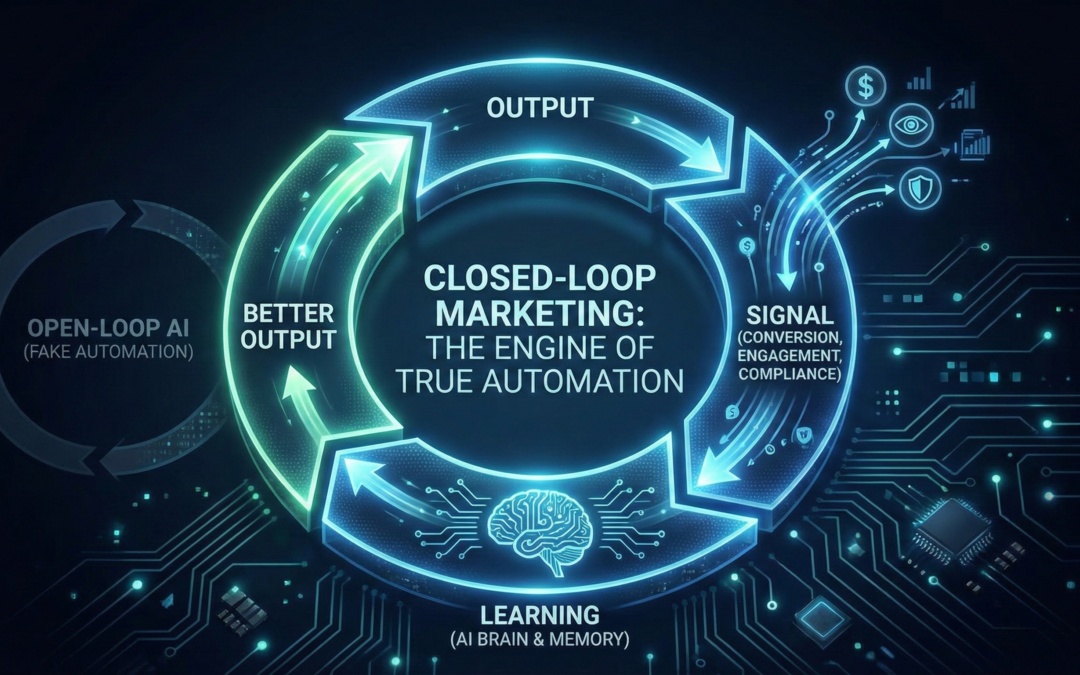
A closed-loop system, on the other hand, is self-aware. It follows a relentless, autonomous cycle:
Output $\rightarrow$ Signal $\rightarrow$ Learning $\rightarrow$ Better Output
When applied to marketing, a true closed-loop AI ecosystem (like Titan Phoenix) doesn't just deploy a campaign. It actively monitors the real-world data coming back from that campaign. It ingests the performance signals, routes that data into its memory architecture, and autonomously adjusts the next output to be more effective.
It doesn't just execute; it learns.
Why “Generate Content” $\neq$ Closed Loop
This is exactly why basic AI tools leave the mid-market frustrated and still paying the Manual Marketing Tax.
Tools like ChatGPT or off-the-shelf copy generators are strictly open-loop. They generate an email or a blog post based on your prompt, but they have no idea if that email actually generated revenue. They do not see the open rates. They do not track the click-throughs. They do not know if the user’s payment cleared.
Because the system cannot see the result, the system cannot learn. Therefore, the burden of analyzing the data, figuring out what went wrong, and trying again falls squarely back on your human workforce. That isn't infrastructure. That is just another manual tool.
The 3 Signals That Actually Matter
For a closed-loop AI ecosystem to operate effectively, its "Left Brain" analytics engine must continuously ingest and process three critical signals:
-
1. Conversion (The Revenue Signal): Did this specific action result in a sale? By integrating with intelligent payment orchestration (like Titan Connector), a closed-loop system knows exactly which campaigns actually drive cleared, multi-rail transactions, not just vanity clicks.
-
2. Engagement (The Attention Signal): Where did the audience drop off? Did they read the first paragraph and leave, or did they watch the entire video? The AI uses this data to autonomously adjust messaging, timing, and ad spend in real-time.
-
3. Compliance (The Guardrail Signal): Is the output legally safe and on-brand? In an enterprise environment, a closed-loop system constantly checks its own outputs against your specific brand guidelines and regulatory constraints before anything goes live.
How to Start Closed-Loop Without Rebuilding Everything
The biggest misconception about closed-loop architecture is that you have to tear down your entire business and spend millions of dollars building a custom AI metropolis from scratch.
You don't. You just need the right orchestrator.
You can begin transitioning from open-loop tools to closed-loop infrastructure by connecting your existing data sources—your CRM, your payment gateways, your ad accounts—into a centralized, agentic AI director. By establishing those feedback pathways, you allow systems like Titan Phoenix to start learning from the data you are already generating.
Stop Guessing. Start Orchestrating.
If your AI doesn't know how much money it made you yesterday, it cannot help you grow tomorrow.
Ready to see where your loops are broken?
Does your blog have a contact page? I’m having problems locating it but, I’d like to
send you an email. I’ve got some ideas for your blog you might
be interested in hearing. Either way, great blog and I look forward to seeing
it grow over time.
You can contact us at rick@rcmdigitalmedia.net or corrine@rcmdigitalmedia.net. We look forward to hearing from you