Data Isolation 101: What Dedicated Client Environments Prevent
In the modern landscape of cloud computing and third-party SaaS, data security is paramount. Your data is your most valuable asset, and a critical component of securing it is data isolation. This blog post breaks down what data isolation really means, why it’s essential, and what controls you should demand from your AI vendors to ensure your sensitive information remains safe.
What is Data Isolation?
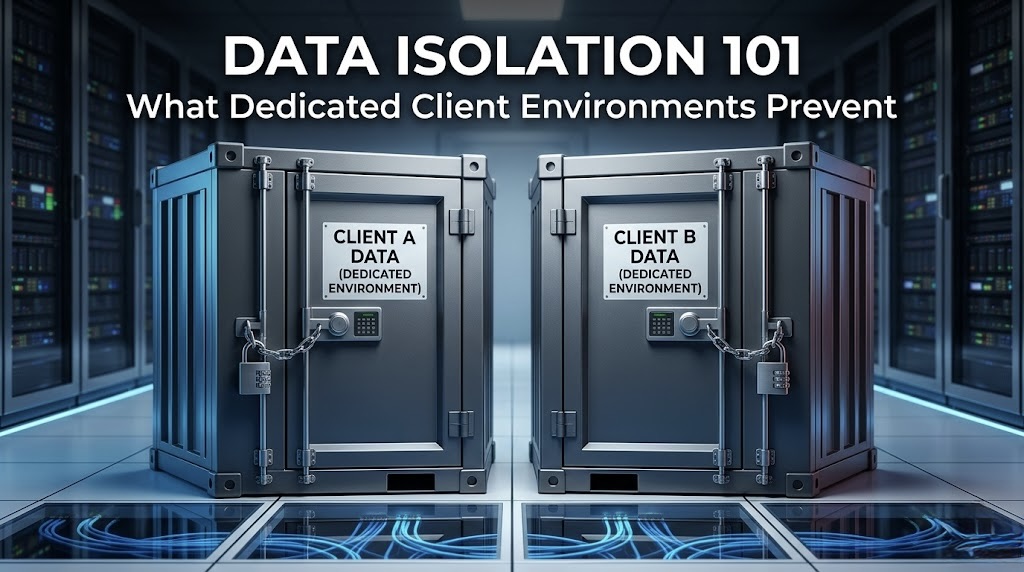
Data isolation is a fundamental security principle that ensures your organization's data is kept separate and distinct from the data of other clients. Think of it like a safety deposit box in a bank vault: your valuables are in your box, and your neighbor's valuables are in their box, both within the overall vault structure, but access to one does not grant access to the other. At RCM Digital Media, we believe true security requires
The Multi-Tenant Risk
The vast majority of SaaS platforms operate on a multi-tenant model. This means that multiple clients share the same underlying infrastructure, including web servers, application servers, and, most crucially, the database.
While multi-tenancy is efficient for vendors and often more cost-effective for clients, it introduces significant risks if not managed properly. The primary risk is data leakage. A bug in the application logic, a weak database query, or a vulnerability in the shared infrastructure could accidentally expose your sensitive data to another client using the same platform. Consider a shared database: if one customer’s application has a security flaw, a sophisticated attacker might find a way to query all the data in the database, including yours.
The Dedicated Client Environment Solution
A dedicated client environment provides a complete separation of infrastructure for each customer. With a DCE, your organization is the only tenant using that set of resources. This eliminates the logical co-mingling of data that occurs in a multi-tenant setup, dramatically reducing the risk of data leakage.
Think of it as having your own private server room in the cloud, rather than sharing a cubicle in a massive open-office.
What DCEs Prevent
DCEs offer a robust layer of protection against several critical risks that are inherently higher in multi-tenant environments:
-
Data Leaks to Other Customers: This is the primary and most significant risk. In a PCE, there is no shared application logic or shared database queries that can cause your data to be exposed to another customer. If another customer of the vendor has a bug, it will not affect you.
-
Privilege Escalation Attacks: In multi-tenant systems, an attacker can sometimes exploit a vulnerability to gain higher levels of access. Once inside a shared environment, they could potentially access data from all customers. In a DCE, even if an attacker were to breach your specific environment, they would only have access to your data, not anyone else’s.
-
Performance Impact ("Noisy Neighbors"): Shared resources in a multi-tenant environment can lead to performance degradation if one customer is using a disproportionate amount of those resources. A dedicated environment guarantees you have access to the resources you are paying for, ensuring consistent performance.
-
Compromise of Shared Secrets or Encryption Keys: If a vendor uses a shared encryption key across multiple customers and that key is compromised, all data is at risk. Dedicated environments allow for completely unique, per-customer encryption keys, local storage of secrets, and single-tenant database instances, all of which are critical for data protection.
The Unique Risks of Multi-Tenancy for AI Vendors
When you use an AI vendor, you aren't just uploading files; you are providing your unique data to be processed, analyzed, and possibly used to train or refine models. This adds an entire dimension of multi-tenant risk.
In a shared AI environment, how can you be certain that your inputs, prompts, fine-tuning data, and the outputs are not being used to inform a model that another customer can access? The risk of "knowledge leak" or "model inversion" is real. Dedicated environments address this critical issue by ensuring that the underlying infrastructure, training data, model fine-tuning, and RAG architectures are completely isolated. Your insights and learnings remain yours alone, not absorbed into a common pool.
The Minimum Controls You Should Expect from AI Vendors
For an AI vendor to credibly claim they are protecting your data with a dedicated client environment, they should be able to prove, at a minimum, the following isolation controls:
-
Complete Infrastructure Isolation: Your deployment should have its own dedicated set of virtual private cloud (VPC) resources, including application servers, databases, and network configuration. No shared resources should sit between your client data and other client data.
-
Dedicated Database Instance: A logical split isn’t enough. You should expect a dedicated, single-tenant database instance that stores only your data. This prevents data co-mingling at the most critical level.
-
Dedicated Secret Storage and Key Management: All sensitive information, from API keys to application secrets, should be stored in a dedicated vault for your organization. Crucially, your data should be encrypted with a unique key that only your organization can use, preventing a single compromised key from endangering all clients.
-
Single-Tenant Model Instances & Fine-tuning: Your training or fine-tuning data, your inputs, and your model's learnings should not cross paths with any other customer's. Your data is kept separate and distinct.
Conclusion
Data isolation is not a "nice-to-have"; it’s a critical security requirement. While multi-tenancy can offer efficiencies, a dedicated client environment provides the essential security foundation your organization needs, especially when trusting an AI vendor with your most valuable data. By understanding the risks that multi-tenancy introduces and demanding the minimum isolation controls, you can confidently navigate the world of cloud and AI, knowing your data is safe and secure in its own private, isolated space.
The Author Bio
About the Authors Corrine and Rick Muenchau are the architects behind RCM Digital Media and the creators of the USPTO-patented Titan Phoenix AI orchestration. Combining Rick’s master-level sales engineering and technical optimization with Corrine’s strategic leadership, they developed the Tripartite Brain model to secure business legacies through agentic commerce. They are dedicated to building strategic fortresses that ensure your data remains your most powerful asset. Truth is the Weapon.
Don't leave your proprietary data to chance in a crowded cloud. At RCM Digital Media, we believe Truth is the Weapon and isolation is the shield. Are you ready to move your enterprise into a dedicated environment designed for growth and security.