Why AI Agents Need Payment Orchestration (Not Just a Payment Processor)
The era of the "shopping cart" is evolving. We are entering the age of Agentic Commerce—a reality where AI agents are authorized to negotiate, procure, and execute transactions autonomously on behalf of a user or a business.
But there is a critical disconnect in the market right now: Businesses are trying to power machine-initiated transactions using legacy payment processors built for human behaviors.
At RCM Digital Media, our premise remains: Truth is the Weapon. And the truth is, if you hand a basic Stripe or PayPal API key to an autonomous AI agent, you are setting your system up for catastrophic failure at scale. To build true autonomous commerce, you do not need a payment processor. You need Payment Orchestration.
Here is why your AI infrastructure must evolve, and how to stop the revenue leak before it starts.
Human Checkout vs. Machine-Initiated Transactions
When a human experiences a declined credit card at checkout, they do what humans do: they pull out a different card, re-enter the expiration date, or call their bank. A human possesses the contextual patience to troubleshoot friction.
An AI agent does not.
When an AI agent hits a false decline, a network timeout, or a cross-border block on a single-rail payment processor, the transaction simply fails. The script stops. The inventory doesn't get ordered, the ad spend doesn't get deployed, and the software subscription doesn't renew.
In an automated system, a failed API call is a permanently lost sale. To power machines, you need a system that can self-heal when it encounters financial friction.
What "Orchestration" Actually Means
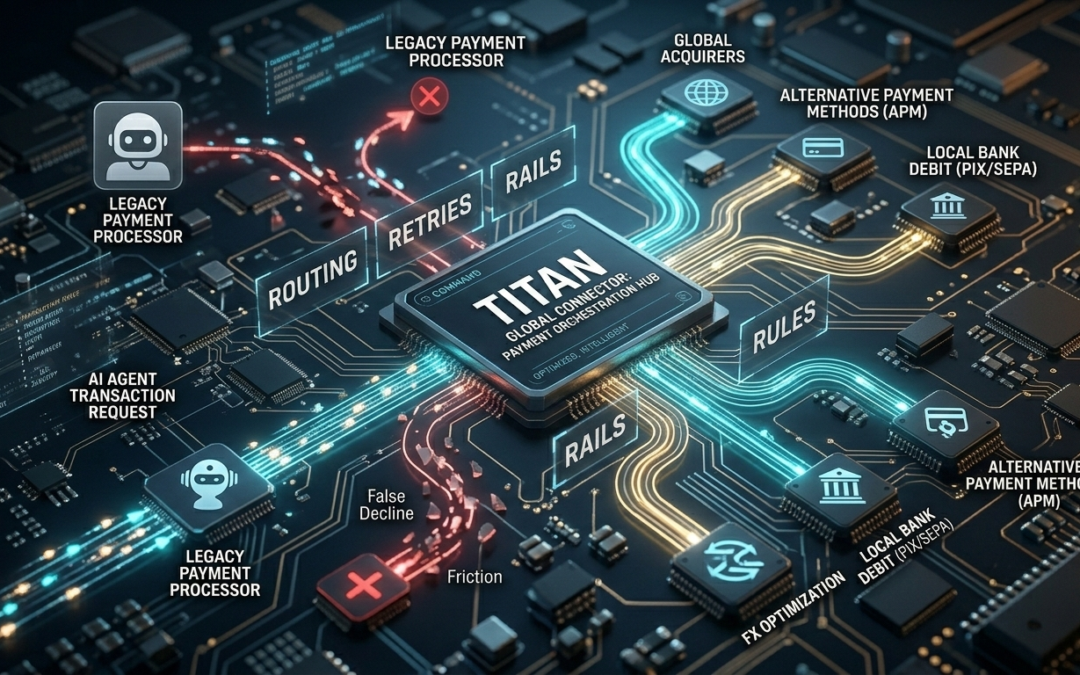
A standard payment processor is a single pipe to a bank. Payment Orchestration (like our proprietary Titan Connector) is a dynamic command center that sits above your processors. It operates on four core principles specifically designed for autonomous agents:
-
Routing (Intelligent Cascading): Not all processors are created equal. Orchestration autonomously routes a transaction to the acquiring bank most likely to approve it based on the BIN (Bank Identification Number), geography, and currency.
-
Retries (Self-Healing Logic): If Processor A declines a transaction due to a generic network error, an orchestration layer instantly and invisibly retries the transaction on Processor B before the AI agent even registers a failure.
-
Rails (Multi-Rail Architecture): AI agents operate globally. They need access to alternative payment methods (APMs) instantly. Orchestration gives your system native access to PIX in Brazil, Alipay in Asia, SEPA in Europe, and ACH in the US, without needing to code individual integrations for each.
-
Rules (Agentic Guardrails): Machines operate at speeds humans cannot monitor. Orchestration allows you to set hard, automated rules for velocity limits, volume caps, and fraud parameters specific to machine-initiated purchases.
The Agentic Revenue Leak: Failures, Friction, and Fees
Relying on a single payment processor for AI commerce creates a massive, invisible tax on your gross revenue. We call this the Agentic Revenue Leak.
The Failure Leak: Legitimate transactions that are blocked because a legacy fraud filter doesn't understand the buying pattern of an AI agent.
-
The Friction Leak: Lost conversions because your system couldn't instantly offer the preferred local payment rail in a foreign market.
-
The FX and Fee Leak: Bleeding margin because your single processor forces exorbitant cross-border foreign exchange (FX) fees, rather than intelligently routing the transaction to a local acquirer.
If your company is doing between $10K and $100K a month in automated or subscription-based revenue, this leak is actively compounding and eroding your bottom line.
Where to Start Building Agentic Commerce
You cannot build tomorrow's AI infrastructure on yesterday's operational plumbing.
If you are a mid-market company looking to deploy AI agents for procurement, automated billing, or programmatic media buying, do not start by writing code for a payment gateway. Start by establishing your orchestration layer.
You need infrastructure that acts as the "Left Brain" of your financial data—rigorous, data-driven, and relentlessly optimized for transaction success.